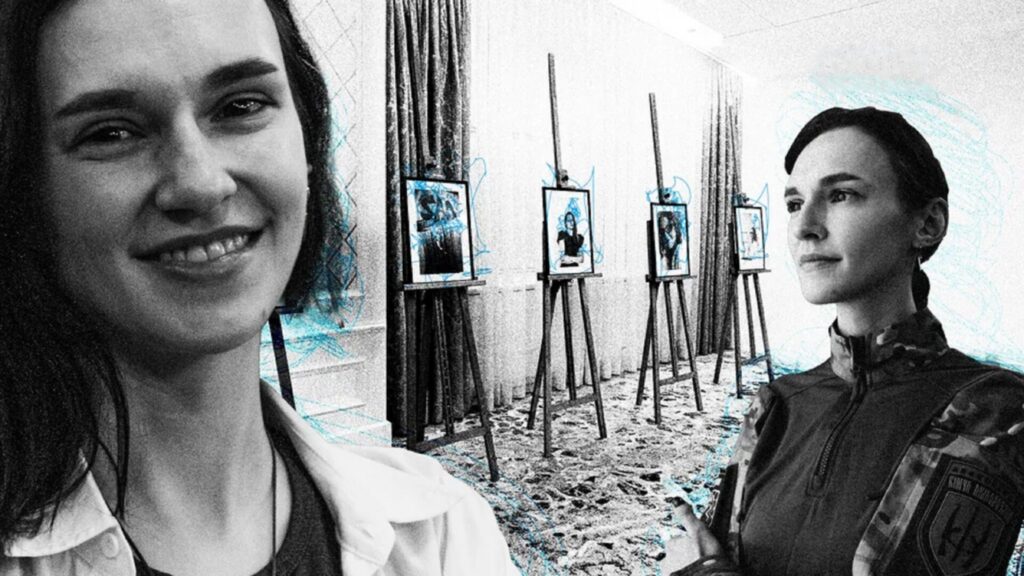
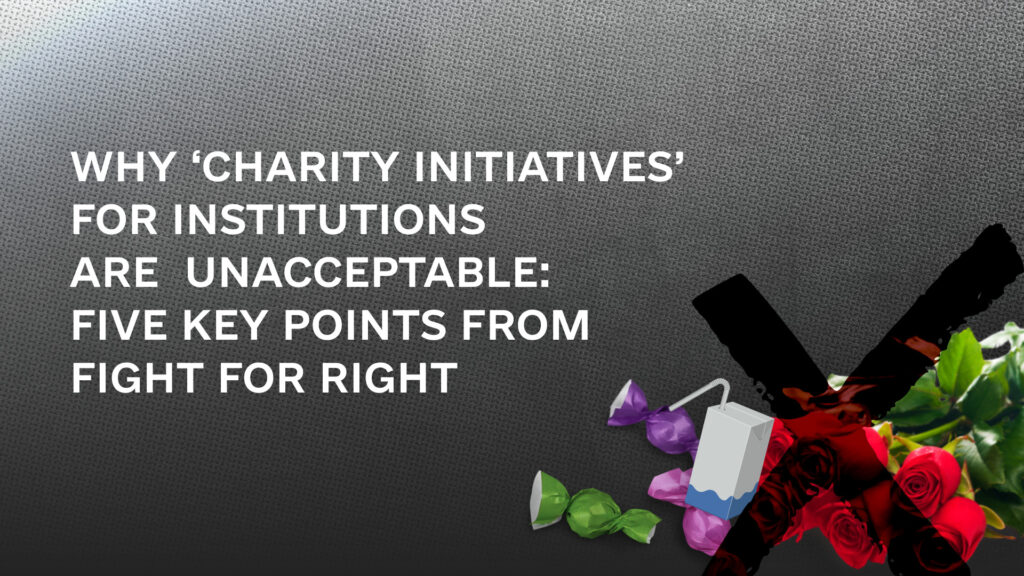
During Christmas, blogger and influencer Olena Mandziuk and veteran and Ukrainian TV-star (Bachelor TV show) Oleksandr “Teren” Budko visited the Vynohradiv Psychoneurological Institution in Khmelnytskyi region, where over 270 men and women are institutionalised, many of them have disabilities. They brought gifts for women—red roses, embroidered blouses, sweets and various household items. Olena also initiated a fundraising campaign to equip the institution with a laundry room and a library.
At first glance, these actions seem like a kind and festive initiative. However, upon closer examination, this approach perpetuates an outdated, paternalistic charitable model of disability that frames people with disabilities as victims requiring pity, sympathy, and care, rather than as individuals with rights and autonomy.
Here’s why Fight For Right finds this form of charity unacceptable:
- Normalizing Existence of Institutions in Ukraine
Olena Mandziuk and Oleksandr “Teren” collectively have an audience of over 1.15 million followers. A Reels about their visit to the Vynohradiv Psychoneurological Institution garnered nearly 14,000 likes, 370 comments, and 400 shares. This content promotes a perception to a large audience that normalizes the existence of the institutional care system in Ukraine.
Meanwhile, human rights organizations have long been advocating for the beginning of deinstitutionalization in Ukraine and raising public awareness about the importance of independent living within communities for people with disabilities. Public figures, including Oleksandr, who is as a person with disability and positions himself as a public advocate, continue to depict institutions as acceptable norms in Ukrainian society.
- Investing in the Institutional System = Supporting the Enslavement of People with Disabilities in Institutions
The fundraiser initiated by Olena to improve living conditions by equipping a laundry and library for women in the institution is, in fact, an investment in the network of institutional care system. This reinforces the existing system in Ukraine, which fundamentally violates numerous human rights of people with disabilities, including the right to independent living, personal autonomy, inclusion in the community.
While improvements like laundry rooms or libraries may change the living conditions, they fail to address the systemic issues of such institutions. These issues include the total deprivation of autonomy for people, the lack of opportunities for personal development, and the denial of independent living. Funds should be redirected to initiatives and programs that develop support services and enable life outside of institutions for people with disabilities.
- People with Disabilities in Institutions ≠ Animals in a Petting Zoo
Many women with disabilities featured in Olena and Oleksandr’s video were openly shown, with their faces visible. Women are filmed in their beds, cornered and confused, wearing just a single sweater with exposed legs, caught off guard. Questions arise about informed consent for the video: did the residents truly understand that the footage would be publicly shared and used for fundraising purposes? Who granted consent for filming individuals deprived of legal capacity by the court?
Beyond legal issues, there is a moral and ethical problem with such footage and publications. Women with disabilities became mere illustrations of the blogger’s charity activities, losing their agency and basic privacy. Residents were dressed in donated embroidered shirts on command, with a facility employee dressing a wheelchair user. The voluntary nature of these actions and the consent of the people remain unclear, but the bloggers obtained a bright showcase of their work.
- Positioning People with Disabilities as Those Who “Lost Their Voice”
Olena and Oleksandr, in their charity campaign, positioned themselves as patrons over the women, presenting them as unable to care for themselves, live independently, make decisions, and entirely dependent on continuous help and care. As Olena noted in her post, Teren “became the voice for those who lost theirs,” yet the blogger failed to highlight the main issue: the women in the institution lost their voices due to the system. This paternalistic charity approach, which Olena has proudly followed for four years, demonstrates a lack of understanding of the real problem of the imprisonment of people in institutions and continues to support these practices. Olena proudly states that she “took the institution under her patronage,” hands out sweets to adult women as if they were children, and unintentionally reveals her perception of people with disabilities as less valuable than herself. The blogger’s reaction to constructive criticism from Olesia Yaskevych, founder of the NGO “Bachyty Sertsem,” further confirms the lack of awareness of the problem of Ukraine’s institutional system among both Olena and her audience.
- Shifting Focus from the Problem of Institutionalization to the “Noble” Actions of Patrons
Nearly all comments under Olena and Oleksandr’s video praise their nobility and heartfelt kindness in bringing joy to the women in the institution. People notice the “happiness and joy” in the women’s eyes, the “smiles on their faces,” the bloggers’ “care,” and their “extraordinary humanity” and define the actions as socially significant. However, behind the veil of roses, embroidered shirts, gifts, and smiles remain such critical issues as the oppressive reality of life in institutions. Most residents in the video are similarly short-cropped “under the machine.” Many women are entirely unsocialized and disoriented, which becomes evident when they interact with strangers. One woman, to whom Oleksandr gave treats, asks him to open the package of pastries and juice, which may indicate the absence of such a basic skill in an older woman. All of this is a result of years of institutionalization and isolation from society.
A Call for Human Rights Based Action
Fight For Right urges leaders and volunteers to follow international standards for the rights of people with disabilities, particularly the UN Convention on the Rights of Persons with Disabilities, and adopt a human rights model of disability. People in institutions do not need roses from The Bachelor, embroidered shirts from a kind blogger, or sweets from patrons. They need freedom and rights:
- To decide where, how, and with whom they want to live.
- To make own choice about our daily life and support services.
- To being included in the community.
Leaders and public figures should direct their media resources and influence not towards supporting institutions but towards meaningful changes in the social sphere to ensure the right of every person with a disability to live independently.